Every training app claims science. This page is what we actually rely on, stated carefully — including the parts that are still open questions.
Experts read earlier, not just faster
Decades of temporal-occlusion research — cutting film off progressively earlier and asking athletes what happens next — show that expert performers extract predictive information from earlier, sparser cues than novices in fast-ball sports. That skill is trainable in the lab. Our Temporal Occlusion module is a direct football application of that paradigm: the film freezes earlier and earlier to push your recognition threshold. We wrote up the transfer question honestly in Does quarterback brain training actually transfer?
The quiet eye
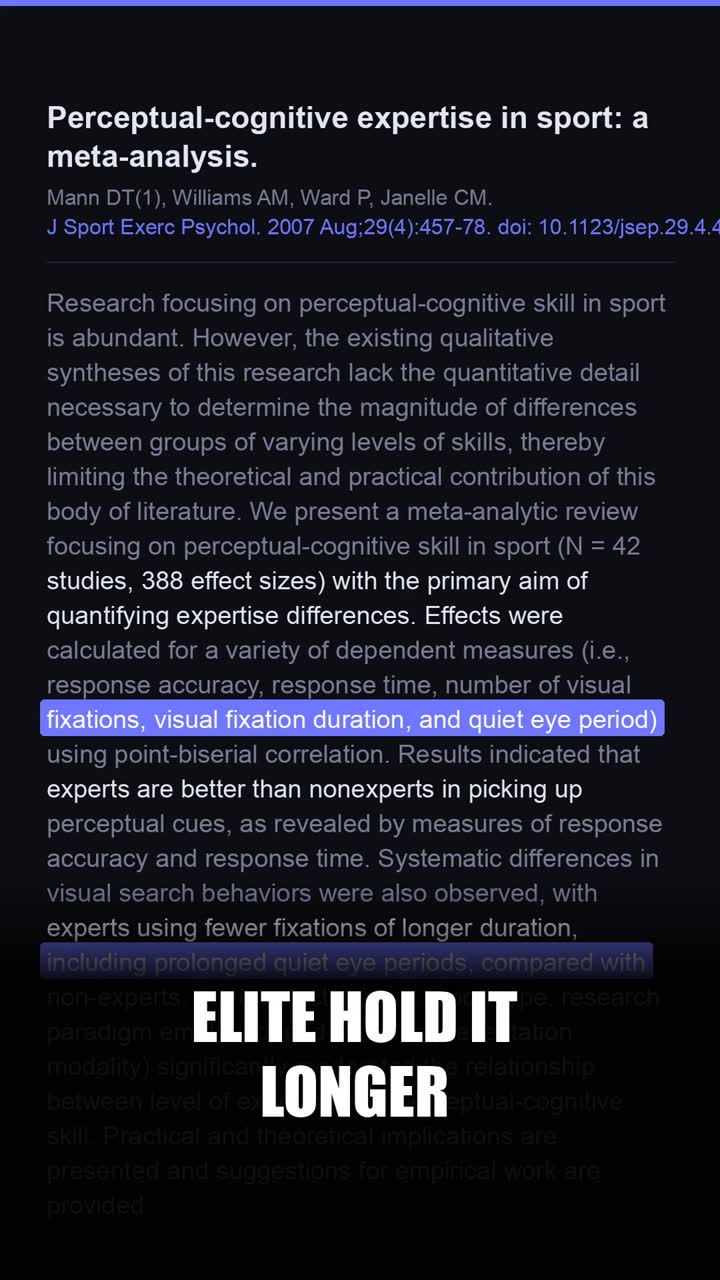
Elite performers across aiming and interception sports show a longer, steadier final gaze fixation before executing — the "quiet eye" described by Joan Vickers and studied extensively since. Gaze stability under pressure is a hallmark of expertise, and it degrades under stress. Our film-room breakdown The quiet eye: the half-second before the throw covers how this shows up for quarterbacks.
The visual hardware: VOR
The vestibulo-ocular reflex keeps your eyes locked on a target while your head moves — which is every dropback, every escape, every throw on the run. VOR function is measurable and trainable; gaze-stabilization protocols are standard clinical practice in vestibular physical therapy. QBFlowDoc's 5-level VOR protocol is that clinical work, adapted for athletes by a DPT. Two honest notes: those protocols were validated in rehabilitation populations, so applying them to healthy athletes for performance is an informed extrapolation — we say so plainly — and to our knowledge nobody else in the QB training space touches this system.
Cognition and movement degrade together
Dual-task research shows that added cognitive load changes gaze behavior and movement quality at the same time — vision and mechanics are not separate systems that fail independently. That is why the app trains decisions under time pressure and body stress rather than in a calm vacuum. Two of our breakdowns dig into this: When the eyes get busy, the feet get loud and Train the fourth quarter.
Read further
Plain-language guides on the specific pieces: quarterback vision training, VOR training for athletes, and measuring processing speed. On whether any of it transfers: does quarterback brain training actually transfer?
What we do not claim
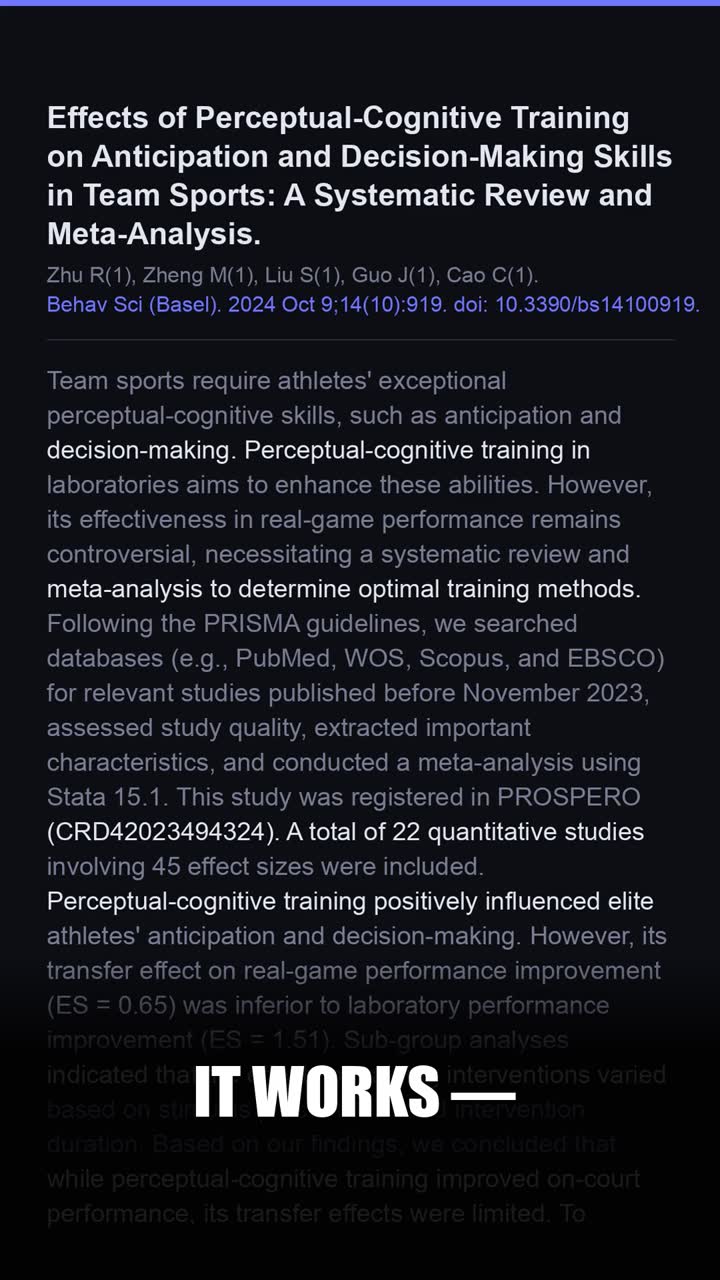
No app can honestly guarantee on-field transfer. Lab-trained perceptual gains sometimes transfer to sport and sometimes don't — the research is genuinely mixed, and generic "brain games" have the weakest transfer record of all. Our bet, stated plainly: football-specific stimuli, timed pressure, and individual baseline measurement give transfer its best chance, and the Processor Rating exists so you can see your own change instead of taking our word for it. The linked breakdowns carry full citations for the claims they make.